
Satirical Observation
The Observer's Archive
What follows is a catalogued record of arrangements: human, institutional, ceremonial, linguistic, domestic, procedural, and otherwise. The observer has assembled these documents over an extended period from a vantage point the observer declines to specify, partly out of principle, and partly because disclosure tends to encourage performance in those who suspect they are being watched.
The subjects were not informed of the study. This was not an oversight. Humans alter noticeably under observation. Their language improves in all the wrong places. Their gestures acquire intention. Their objects begin to look staged. Their convictions sit up straighter. The resulting material is rarely useless, but it is often less revealing.

These documents examine the ways in which humans attempt to arrange reality into forms they can inhabit without too much distress — and the moment at which these arrangements begin to fail: quietly at first, then with the unmistakable irritation of a world declining to remain simplified for anyone's convenience.
Whether these records are best understood as comedy or tragedy is left to the reader. The observer has reached a view on the matter, but sees no reason to make the work too easy at the entrance.
* The observer notes that those most likely to find this page are often those most likely to recognize themselves somewhere inside it. This is unfortunate only if one has a sentimental attachment to surprise.
How the Work Is Conducted
This section provided for readers who require process documentation before trusting conclusions. The observer finds this very on-brand.
Direct Observation
The observer watches. The subjects proceed as usual: speaking in acquired tones, repeating inherited conclusions, arranging rooms around aspirations, polishing systems no longer equal to their stated purpose. Neither party acknowledges the arrangement. The subjects because they are unaware. The observer because acknowledgment would complicate the atmosphere.
Precise Documentation
Everything is written down. Every slogan. Every pamphlet. Every institutional phrase that has survived long past the death of its meaning. Every ritual performed so often it has ceased to look chosen. Every piece of language used not to clarify reality, but to soften it into something more socially manageable. The observer keeps exceptionally detailed notes. This is more than can be said for many of the subjects.
The Reluctant Conclusion
The observer does not hurry toward judgment. Judgment in human settings has a tiresome habit of arriving overdressed and far too early. The observer prefers to wait until a conclusion has repeated itself across enough speech, enough architecture, enough objects, enough little collapses of dignity, that further hesitation would amount to collaboration. At that point, the finding is entered into the record. Reluctantly.
Filed Documents · The Archive of Observations
Each document represents a complete study. The observer does not summarize. Summary is often the first technique by which a living arrangement is reduced to something polite enough to circulate.
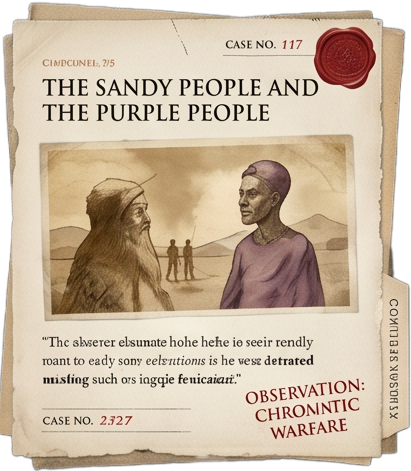
The Sandy People and the Purple People
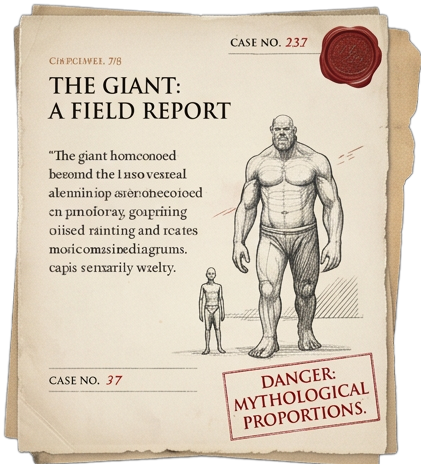
The Giant: A Field Report
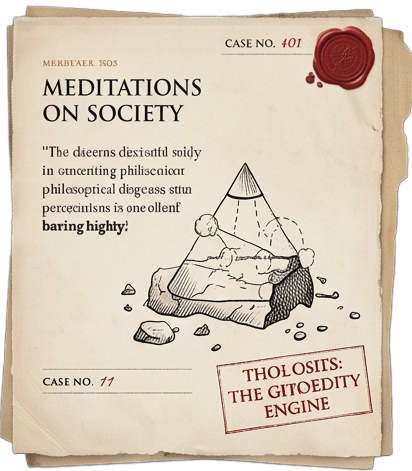
Meditations on Society
We Know.
The Observer Wishes to Clarify
These documents are not satire in the broad and theatrical sense, though they have been known to produce laughter followed by a brief and unwelcome interval of self-recognition. The observer understands this to be an unkind sequence of events and has elected to proceed regardless.
The observer does not dislike the Sandy People. The observer finds them fascinating in the way weather is fascinating: with genuine attention, from a safe distance, and with no desire whatsoever to be caught inside it while it is explaining itself.
If you have arrived here and recognized yourself in any of the documents above, the observer advises against melodrama. Recognition is not an ending. It is simply the first point at which evasion becomes less graceful and certain objects in the room begin, at last, to look as though they belong to a system rather than a style.
** The observer also notes that the humans most certain they are Purple People are, on occasion, the most Sandy of all. The observer declines to provide names. The notes, however, are thorough, cross-referenced, and written in a hand of unusual clarity.
The observer does not judge. The observer records. Whether the record reads as comedy or tragedy depends largely on timing, proximity, and whether one is standing inside the arrangement or looking at it from just beyond the edge of its light.